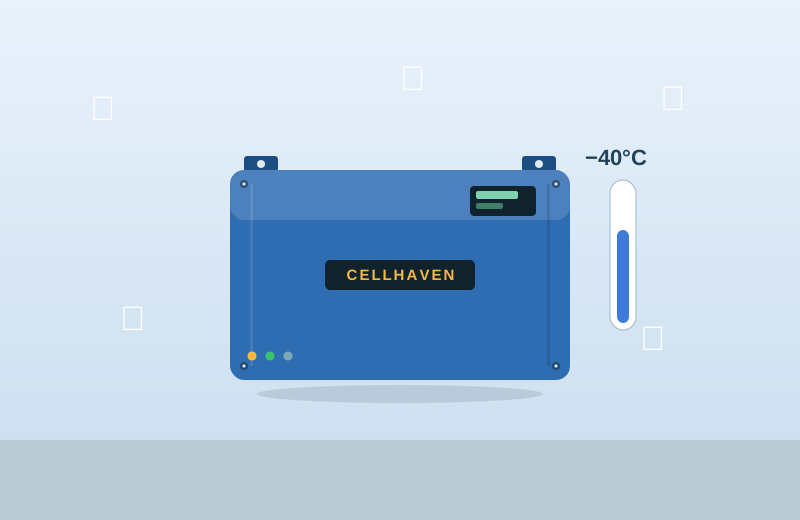
"Low-temperature battery" is not a specification. It is a label, and labels hide the only question that matters: at what temperature, discharging how much current, for how many cycles? A pack quoted for "winter use" can mean a unit rated to discharge at −40°C, or a standard pack with a warmer marketing department. The difference shows up in January, in a yard full of vehicles that will not start. This guide reads the real specification tables the way a buyer should — the low-temperature family, whose two flagship models (72V 50Ah and 60V 25Ah) supply the figures used below, plus the family's cold-storage AGV battery.
Start with the discharge window, stated in degrees
The discharge temperature range is a pair of numbers, not an adjective. On the 72V 50Ah pack it reads −40~60°C. On the 60V 25Ah pack, the same: −40~60°C. The 24V 60Ah AGV battery built for cold-storage shuttles repeats it. Three models, one window, stated identically — that is what a product family designed around a limit looks like. Contrast the quotes that offer "cold resistance" with no range attached. No range, no rating: treat such a pack as a standard-temperature unit whatever the brochure calls it.
Read the charge window separately — it is always narrower
Now the line most buyers never reach. Charge temperature, 72V 50Ah model: −10~45°C. Discharge goes to −40; charge stops at −10. The 24V cold-storage battery is more permissive — charge −20~45°C — because its duty (shuttles that charge at a dock inside or beside the cold store) demanded it. The 60V 25Ah model states no charge window at all: treat the gap as an enquiry question, not a number to assume from a sibling model. Plan around the real numbers. Vehicles that work outdoors at −30°C charge indoors, or in a heated enclosure, or on a schedule that brings them in warm. The 72V pack's standard charge current is 10A (20A maximum), so a full charge from the 84.0V charger class is an overnight job, not a coffee break — that, too, belongs in the operating plan before the purchase order, not after.
Check the current the pack holds, not just that it works
Temperature windows say where a pack works. Current figures say how hard. From the same tables: the 72V 50Ah pack discharges 40A continuous, 120A pulse, maximum load 2500W. The 60V 25Ah pack: 20A continuous, 60A pulse, 1200W maximum load. The 24V cold-storage battery: 40A continuous, 120A pulse — a pulse three times its continuous figure, because shuttle duty is start-stop all shift. Internal resistance is ≤150mΩ on the 72V model, which is the number behind the pulse rating: resistance is what sags voltage when a cold pack is hit with 120A. A quote that gives a temperature window without continuous and pulse current is giving you half a specification, and the missing half is the half that stalls motors.
Cycle life and the rest of the table
Cold duty wears a pack faster than temperate duty, which makes the cycle rating worth a look before price even enters the conversation. Both flagship low-temperature models here sit at 1000 cycles or more; the cold-storage AGV battery is rated at ≥1000 cycles as well. Then there are the unglamorous lines buyers skip: working voltage range (84.0–40.0V on the 72V pack), cell arrangement (10P20S — 3.7V 5000mAh cells), storage temperature, dimensions, weight. Read them anyway. A complete table is a signal in itself. Manufacturers who actually run the cold chamber tend to publish like it; manufacturers who don't, publish adjectives.
Storage and standby are part of the rating too
Equipment that works in the cold usually waits in the cold as well. Check the storage temperature line before assuming a pack can sit in an unheated depot all winter: the 72V 50Ah model has a storage window of −40~45°C, the same floor as its discharge window, which is exactly what standby duty needs. The 60V model gives no storage line — ask, if the pack will winter outdoors. Receiving inspection in cold countries has one extra step: a pack delivered at −20°C goes to the warm room before it goes on the charger, because the charge floor applies to the battery's temperature, not the room's, and a cold-soaked pack in a warm room is still a cold pack for its first hours.
Match the charger to the cold plan
Finally, close the loop on charging hardware. A 72V low-temperature pack charges in the 84.0V class; a 60V pack in the 67.2V class. Both classes exist in the aluminium-shell charger line at 10A — and 10A is not an arbitrary size for the flagship: it is the standard charge current of the 72V pack itself (20A maximum), so the charger runs the pack at its rated standard rate rather than forcing a choice between trickle and overdrive. The cold-storage battery has its own matched charger, a 29.4V 20A unit. If the charging point is itself unheated, that constraint belongs in the enquiry — the charge window floor (−10°C on the flagship, −20°C on the cold-storage model) may move the charger indoors even when the pack works outdoors, and it changes which charge schedule makes sense.
The third cold model: the cold-storage AGV battery
Most buyers reading this guide are choosing between the two vehicle packs, but the family has a third low-temperature model worth the same close reading as either: the 24V cold-storage AGV battery. Read it as an examiner. Its discharge window matches the family's widest (−40°C to 60°C) and its charge floor is the family's most permissive (−20°C) — the pairing that defines cold-store logistics, where the battery works in the freezer and charges at the dock. Its cell line is given down to the arrangement — 3.7V 5Ah cells in a 7S12P build: seven in series makes the 24V class (the model is also stated at 25.9V nominal), twelve in parallel makes the 60Ah. Its pulse discharge (120A) is triple its continuous 40A, sized for shuttle acceleration rather than cruising. Its dimensions and weight are 120×310×330mm and about 13.5kg, it carries RS-485 communication with protocol, and its cycle rating (≥1000) is quoted against a duty that runs several rotations a day, which a fleet manager can convert directly into a replacement budget. A specification that survives this kind of reading is the kind worth buying from; the exercise transfers to any supplier's table, in any family.
Charging a cold fleet: the depot is part of the battery
Every low-temperature pack in the catalogue charges within a window, so the depot's temperature is a specification of the installation, not a comfort detail. The planning numbers: the 72V flagship charges at 10A standard on its 84.0V class (an 840W charger model); the 60V pack's ceiling class is 67.2V at 10A (672W); the cold-storage battery's matched unit is 29.4V 20A (588W). A six-vehicle winter fleet on 10A units draws on the order of 5kW of charger nameplate, behind charger efficiency of 85% or better for the aluminium series — a dedicated circuit and a ventilation allowance, both planned once and forgotten. The depot's thermometer matters more than its size: the flagship's charge floor is −10°C, and an unheated depot in a hard January can sit below it on exactly the nights the fleet most needs a full charge. Fleets solve this three ways: heat the charge corner, schedule charging into the building's warm hours, or work to the cold-storage model's wider −20°C charge floor where the duty allows the 24V class. What fleets do not do is charge at full rate in deep cold and blame the batteries in March.
Worked sizing: five survey vehicles through a winter
Five vehicles, instruments drawing 600W average, 1,800W sustained maximum, ten-hour field days, base at −30°C. Energy per vehicle per day: 6kWh at average draw. One 72V pack stores 3.6kWh — so the fleet plan is two packs per vehicle in rotation, or one pack and a midday top-up at a heated field shelter. Two-pack rotation is the professional answer: ten packs working, five charging or resting, each pack cycling about once per day against its ≥1000-cycle rating. Charging: the 84.0V 10A class restores a pack in about five hours at the standard rate, so five chargers on a night rotation cover the fleet inside an eleven-hour window. Spares: one pack and one charger per five vehicles is the fleet's insurance line, bought once. That is a winter programme specified end to end from three numbers per pack — energy, charge rate, temperature window — which is the entire argument of this guide restated as a shopping list.
A short checklist
So, before ordering, five things — all from the manufacturer's own table, all in writing. The discharge range, in degrees. The charge range, stated separately, because it will be narrower and you need to plan around it — and where a model is silent, as the 60V model is on charge temperature, the question goes in the enquiry. Continuous and pulse current, stated next to the temperature figures rather than in some other document. Cycle life. And the charger class that matches the pack's charge voltage. Missing one? Ask. A supplier who has the number will send it; a supplier who sends adjectives instead has answered you. The models referenced in this guide carry nearly all five, which is exactly the standard to hold every other quote to. One last practical note: size the envelope early. The two flagship packs bracket the range — the 60V 25Ah model, at 75×200×365mm and about 8.5kg, is a one-person carry for instrument and light vehicle duty; the 72V 50Ah model, at 150×215×425mm and about 22kg, is a bolt-down installation in most vehicles. Cold-rated capacity you cannot physically fit is not capacity at all.
Transport and storage notes for cold-climate buyers
Cold-climate programmes import their batteries across weather, so the logistics belong in the selection. Transport: lithium batteries move under dangerous-goods rules (the company lists UN38.3, the transport test regime, among its product certifications), and the buyer's side of that is documentation — request the test summary and the shipping classification with the order, not after the freight is booked. Storage between seasons matters as much: a pack laid up for a summer should sit at partial charge in a cool, dry store, with its state checked on a calendar rather than discovered flat in October. The flagship's storage window (−40~45°C) is the line to check a store against. And freight planning runs backwards from the first frost across the longest leg, adding the commissioning weeks — the order date that falls out is rarely the one an unplanned programme chooses, which is the entire point of computing it.
Questions buyers actually ask about low-temperature packs
Can I charge below the floor at all? The packs are specified to charge from −10°C (the vehicle flagships) or −20°C (the cold-storage model); the disciplined answer is to charge warm wherever the installation allows it, and to treat the floor as a specification, not a suggestion. What happens at the discharge floor? The protection system ends the discharge as a managed cutoff; the working design keeps the duty ten degrees inside the floor so the cutoff is a safety net, not an event. Does cold reduce capacity permanently? Cold reduces delivered capacity while the pack is cold; the pack recovers its room-temperature behaviour when it warms. Any retention figure a supplier quotes should come with its temperature and discharge rate attached — a number without those two conditions is marketing. Which model for a vehicle that also works in summer? Both vehicle packs discharge to +60°C, so the summer duty is served by the same pack; what changes seasonally is the charging location's temperature management. What should my first message contain? The vehicle or instrument, its average and peak draw, the coldest working and charging temperatures, the daily hours, and the destination market — five facts that turn a catalogue into a quotation.
The cold numbers on one page
Flagship pack: 72V nominal, 50Ah, 3.6kWh, working range 84.0–40.0V, discharge 40A continuous and 120A pulse, maximum load 2500W, charge 10A standard and 20A maximum, charge window −10°C to 45°C, storage −40°C to 45°C, dimensions 150×215×425mm, about 22kg, ≥1000 cycles. Smaller pack: 60V, 25Ah, 1.5kWh, 67.2–40.0V, 20A continuous, 60A pulse, 1200W, cells in a 5P16S build, 75×200×365mm, 8.5kg, cycle life ≥1000. Cold-storage AGV pack: 24V (25.9V), 60Ah, about 1.44kWh, 40A continuous, 120A pulse, 3.7V cells in 7S12P, discharge −40°C, charge floor −20°C, ≥1000 cycles, 120×310×330mm, about 13.5kg, RS-485. Matched charger classes: 67.2V 10A (672W) for the 60V ceiling and 84.0V 10A (840W) for the 72V class, with series efficiency of 85% or better; a 29.4V 20A matched unit for the cold-storage battery. Planning ratios used in this guide: peak draw held under the pulse rating with margin; continuous draw at or under seven-tenths of the continuous rating for sustained duty; working temperature held ten degrees inside the discharge floor; charging located at least five degrees above the charge floor. Every figure traces to a model page in the catalogue; the guide's whole method is to read them together.
The last word. A low-temperature battery is not a product category, it is a set of numbers that either closes over your duty or does not. Read the window, the currents, the charge floor and the cycle line; run the division between your nightly energy and the nameplate; put the charger in a warm room; and let the suppliers whose tables cannot survive those four acts sell to somebody else.
The charger line, read as a cold-weather case
The aluminium charger series deserves a paragraph of its own in a cold-weather guide, because winter programmes live or die at the charge point. The series' shared data: efficiency of 85% or better at rated load, red/green two-LED indication, an IEC input socket, input of 220Vac on selected models across a 200–240Vac range at 50–60Hz, a 1.5 m power cord and a 1.0 m output cord. The two models that matter here are the class ceilings: 67.2V 10A at 672W, and 84.0V 10A at 840W. Note what the series does not offer at these ceilings — a faster rung. The 72V flagship's own standard charge current is 10A, so the catalogue's answer to "how fast can I charge it" is "at its rated standard rate", and any programme that needs a shorter turnaround should plan pack rotation, not charger bravado: two packs per vehicle and an overnight rhythm beats one pack charged hopefully. The efficiency figure belongs in the depot plan as well — at 85%, an 840W charge point draws just under a kilowatt from the wall, and a heated charge corner for six vehicles is a 6kW electrical conversation held once, in autumn, rather than a tripped breaker discovered in January.
Receiving inspection for a cold-climate order
Cold programmes buy in summer and discover problems in winter, so the receiving inspection carries unusual weight. Work from the tables. Identity: the model's voltage class and cell arrangement against the order — 10P20S for the 72V flagship, 5P16S for the 60V pack, 7S12P for the cold-storage battery. Envelope: a tape measure against the printed dimensions — 150×215×425mm, 75×200×365mm and 120×310×330mm respectively — because a winter vehicle programme cannot re-machine battery trays in December. Mass: a scale against about 22kg, 8.5kg and 13.5kg. Electrical: open-circuit voltage inside the working range (84.0–40.0V, 67.2–40.0V), and a supervised first charge at the standard rate in a warm room, watched end to end. Documentation: the matched-charger data where one exists (29.4V 20A for the cold-storage battery), the communication protocol document for the RS-485 models, and the transport paperwork — UN38.3, which the company lists among its product certifications, and the test summary belongs in the shipment file. An hour per model at the dock in September is the cheapest cold-weather engineering there is.
What the cold does to the rest of the vehicle
A guide about batteries should admit that the battery is not the only component winter tests. Lubricants thicken, tyre pressures fall, instrument displays slow, and every connector on the vehicle is a contraction joint. The battery's window should therefore not be planned against in isolation: a vehicle whose pack discharges to −40°C but whose hydraulics sulk below −25°C is a −25°C vehicle, and the fleet plan should be written to the weakest system, with the battery's margin held as reserve rather than spent as specification. The same logic inverts in the charge corner: the pack's charge floor (−10°C on the flagship, −20°C on the cold-storage model) may be the warmest requirement in the building, which makes the battery — usefully — the component that sets the depot's heating specification. Programmes that write both numbers into the site plan, weakest-system floor and charge-corner floor, stop having winter surprises of the avoidable kind.
A second worked case: the cold-store shuttle fleet
Six shuttles, a cold store at −28°C, four-hour rotations around the clock. The battery evidence: the 24V 60Ah cold-storage model, discharge window −40~60°C (eleven degrees of margin under the store's temperature), charge window from −20°C (the dock, not the aisle, is the charge point), 40A continuous against the shuttles' cruise draw, 120A pulse against their acceleration, ≥1000 cycles against a duty of six rotations per vehicle per day across the pool. The pool arithmetic: at roughly three hours of matched-charger turnaround (29.4V 20A, 588W) against four-hour rotations, two packs per vehicle keep the rotation honest, twelve working packs plus two spares cover the fleet, and seven charge points on a staggered schedule draw under 5kW from the depot circuit at the series' efficiency. The replacement budget writes itself from the cycle figure: a pool pack cycling about three times a day reaches its 1000-cycle rating in about a year of rotations, so the programme budgets a rolling replacement of roughly one pack per vehicle per year and holds the spares line accordingly. Every number in that paragraph is a model or charger figure — which is, again, the guide's whole argument.
Terminology, so the enquiry says what it means
Four terms do most of the damage in cold-battery correspondence, and fixing them costs nothing. "Working temperature" without charge/discharge separation means the writer has not read a table; always write the pair. "Capacity" at an unstated temperature is a summer number wearing a winter coat; the catalogue's capacities are nameplate, and winter planning divides them by the duty's own experience. "Fast charging" below the charge floor is not fast, it is refused — the protection system ends the conversation the brochure started. And "low-temperature battery" as a product name should always be followed, in any serious document, by the discharge floor in degrees: −40°C in this family's case. An enquiry written in those terms — windows as pairs, capacities with temperatures, rates with floors — is recognisably professional to the engineer who answers it, and the answer it gets is the engineering answer rather than the sales one.
Cold duty at body scale: the heated-clothing outlier
The family's strangest low-temperature case is not a vehicle pack at all: the heated-clothing family, whose unit is a temperature-controlled polymer battery of 3.7V 3000mAh for heated gloves, alongside a switch line rated at a maximum of 3.5A across a 3.7V–14.8V range. The duty is a human being: the load is watts, the runtime is a working day outdoors, and the failure mode is not a stalled vehicle but cold hands at hour six. The figures are correspondingly modest and correspondingly exact — a named capacity, a named control function, a named current ceiling — and the buyer of heated workwear should read them the same way the fleet buyer reads the flagship table: what is the draw, what is the day, does the arithmetic close? Small batteries reward the same discipline as large ones; they merely punish its absence more quietly.
The solar sideline: winter's other battery
Solar street lighting is the duty where winter and batteries meet without a vehicle anywhere: the shortest days, the longest nights, and a battery that must bridge both. The solar family carries two models — a 12V 55Ah unit (≤20A continuous, ≤60A pulse, ≥500 cycles, 75×170×210mm, about 4.2kg) and a 12V 30Ah unit (≤10A continuous, 75×120×200mm, about 2.6kg) — serving street lights, integrated solar lights, landscape and courtyard lighting, monitoring and base stations. Neither model states a temperature window — read that the way this guide taught in its first sections: as an enquiry item, not an assumption. A lighting programme in a cold region should ask the window question explicitly and size the winter night from the answer — nameplate capacity against the longest night's load, with the panel's shortest-day harvest on the other side of the ledger. The models' cycle ratings (≥500 on the larger unit) are spent nightly, which makes a solar light a roughly two-year battery programme wearing a ten-year luminaire — plan the replacement with the purchase.
The storage family's cold answer, for contrast
The storage family's wall unit — a temperate-duty product — has a discharge window of −20~60°C: respectable, indoor, and twenty degrees short of the low-temperature family's floor. Nothing about that is a defect; the unit is specified for rooms, and rooms are not freezers. A buyer who needs −40°C and accepts a −20°C table because the product was described as "cold-capable" has bought a January failure at a summer price, and the description will not be there to help when it happens. Windows are numbers; adjectives are weather. Hold every table to that split, in this catalogue and every other.
A glossary for the table, in plain terms
Working range: the voltage span across which the pack may be used, from its charged ceiling to its discharged floor — the inverter's and charger's settings live inside it. Nominal voltage: the class name (72V, 24V, 51.2V), useful for conversation, useless for settings. Standard charge current: the rate the manufacturer rates for ordinary use; maximum charge current is the ceiling, not the habit. Continuous discharge: the current the pack can sustain; pulse discharge is the seconds-scale figure for starts and surges, and the ratio between them describes the duty the pack was built for. Internal resistance: the pack's opposition to current flow, stated in milliohms, which becomes voltage sag under load and heat under everything. Depth of discharge: how much of the nameplate a cycle spends, the silent partner of every cycle-life figure. State of charge: how full the pack is, the number a communication protocol exists to report. A buyer fluent in those seven phrases can read any table in this range — and, more to the point, can tell when a table from anywhere else is avoiding them.
The two-wheeler winter question
Light electric vehicles ask the cold question in its most ordinary form: a delivery rider, a January morning, a scooter that slept outside. The catalogue's two-wheeler series is ternary — twelve models in iron cases across 48V, 60V and 72V, ≥800 cycles, ≤800W — and the series makes its winter point by omission: no −40°C discharge window for the series, because that is not the duty it was built for. Its example rows give range figures instead (about 50km, 55km and 60km at the three voltage classes' 22Ah points) and charger pairing by range top (58.8V, 71.4V, 84.0V). A fleet operator running winter delivery should read the series exactly that way — as a temperate-duty product with honest range data — and put the window question in the enquiry for any sub-zero programme, where the answer will be a different family or a managed regime of indoor parking and warm charging. The discipline transfers: match the product to the season it was specified for, and treat every out-of-window use as an experiment whose results arrive in February.
Designing the charge corner
Since the charge floor is the constraint winter programmes actually trip over, the charge corner deserves design rather than discovery. Its elements, from the models' own data: a room or enclosure held at least five degrees above the strictest floor in the fleet (−10°C for the vehicle flagships, −20°C for the cold-storage model); charge points labelled by ceiling — 67.2V and 84.0V for the vehicle classes, 29.4V for the cold-store shuttles — because the plugs will not warn anyone; circuits sized from the wattages at the series' efficiency (six 840W points are a six-kilowatt conversation; seven 588W matched units are a five-kilowatt one); and a rotation board, physical or digital, that dispatches packs by reported state of charge where the packs report it — the cold-storage battery's RS-485 line exists for exactly this. None of that is exotic. All of it is cheaper in October than in January, which is the entire economics of winter preparation in one sentence.
Four trade-fair myths, retired
Myth one: "all lithium batteries hate the cold equally." The range itself refutes it — one family discharges at −40°C, another at −20°C, and the difference is twenty degrees of engineering. Myth two: "a bigger battery solves winter." Capacity is not the binding constraint at the season's edge; the charge floor is, and a bigger pack charged warm beats a huge pack charged cold every week of the year. Myth three: "the BMS will handle it." A protection system handles limits by ending them — it is a fence, not a heater, and a fleet that meets its fences daily has a planning problem wearing a safety system's clothes. Myth four: "winter figures are conservative anyway." Published windows are specifications, not negotiating positions; the programmes that treat them as such are the ones still running in year three. The antidote to all four is the same piece of paper this guide began with: the model's own table, read in full, in the warm, before the purchase order.
The paperwork pack for a winter programme
Close with the paperwork, because winter programmes are audited by their first failure. Per model, the file should hold: the specification table (windows as pairs, currents as pairs, cycle figure with any stated conditions); the matched-charger document where one exists, or the charger selection record where the pairing was made at enquiry; the communication protocol document for the reporting models; the transport file, including the UN38.3 test summary; the warranty line (≥1000 cycles is a rating, 12 months on the industrial models is a term — different documents, both filed); and the site plan showing the charge corner's temperature against the strictest floor. Six items. A programme that can produce them on request has understood this guide; a programme that cannot will learn its contents from the season instead, at the season's rates.
The enquiry, written properly
Everything in this guide converges on one short document, and it is worth printing as a template. Subject: the duty, in five words. Body: the equipment (vehicle, instrument, shuttle, luminaire); its average and peak draw; the coldest working temperature and the coldest charging temperature, stated separately; the daily hours and the turnaround window; the communication the host expects, if any; and the destination market, for the documentation file. Attach the incumbent battery's data if one exists. That message — perhaps one hundred and twenty words — contains every fact this guide has used, and it will be answered by an engineer with a model recommendation, a charger pairing and a documentation list. The enquiries that cannot be answered are the ones that begin with a price and a photograph. Winter is unforgiving of many things, but it is entirely fair: it punishes exactly the specifications that were never written down, and it respects, to the degree, the ones that were.