Home › Family › 72V 50Ah Low-Temperature Lithium Battery Pack
Low-temperature family — model page
72V 50Ah Low-Temperature Lithium Battery Pack
This 72V 50Ah pack is the flagship of the low-temperature family, built from 3.7V 5000mAh cells in a 10P20S arrangement and rated to discharge from −40°C to +60°C. It is specified for vehicle equipment, survey and exploration instruments, medical devices, instruments and meters, communications and security equipment.
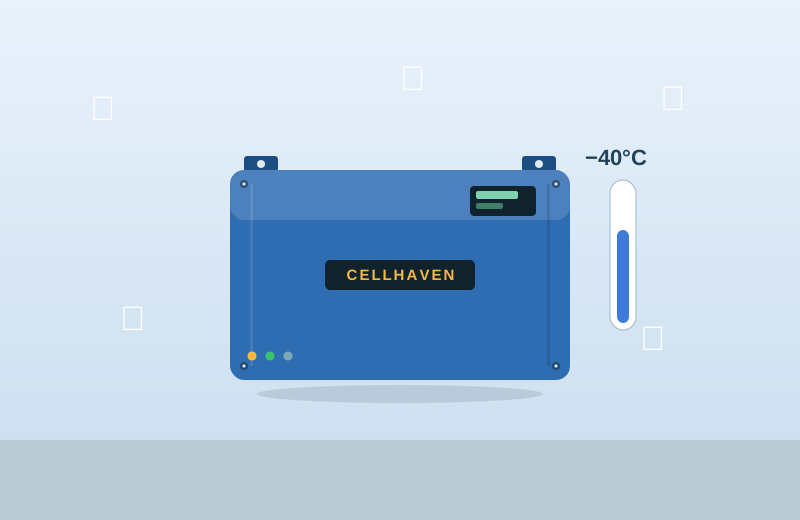
Key data — 72V 50Ah Low Temperature Battery (−40°C Discharge)
| Nominal voltage / capacity | 72V / 50Ah |
|---|---|
| Working range | 84.0–40.0V |
| Cell combination | 3.7V 5000mAh, 10P20S |
| Charge current | 10A standard / 20A max |
| Discharge current | 40A continuous / 120A pulse |
| Maximum load | ≤2500W |
| Cycle life | ≥1000 cycles |
| Charge temperature | −10~45 °C |
| Discharge temperature | −40~60 °C |
| Storage temperature | −40~45 °C |
| Dimensions | 150×215×425mm |
| Weight | ≈22kg |
| Internal resistance | ≤150mΩ |
| Finish / connector | Blue PVC heat-shrink / 50A Anderson plug |
Reading the rating
The working range is 84.0–40.0V. Standard charge is 10A (20A maximum); continuous discharge is 40A with a 120A pulse, for loads up to 2500W. Charging is rated −10~45°C and storage −40~45°C — the honest split that matters in the field: the pack discharges at −40°C, and the charge window is stated separately rather than implied.
Build
The pack is finished in blue PVC heat-shrink with a 50A Anderson plug, measures 150×215×425mm, weighs about 22kg and carries an internal resistance of ≤150mΩ. Cycle life is rated at ≥1000 cycles.
The 72V 50Ah specification
Start with the cell combination, because everything else follows from it: 3.7V 5000mAh cells in 10P20S — ten cells in parallel for capacity, twenty in series for voltage. Twenty times 3.7V gives the 72V-class nominal; twenty times 4.2V gives the 84.0V top of the working range, and the range runs down to 40.0V. Ten parallel 5Ah cells give the 50Ah. Nominal energy is therefore about 3.6kWh in a 22kg pack — roughly 164Wh per kilogram, which is the figure to compare when a vehicle designer asks whether the pack earns its space.
Discharge is where the model is specified hardest. Continuous current is 40A — 0.8C against the 50Ah capacity — and the pulse rating is 120A, three times the continuous figure, for motor starts and short load peaks. Maximum load is capped at 2500W: at 72V nominal the continuous current alone would allow more, so the 2500W cap, not the 40A, is the binding design limit for sustained loads. Internal resistance is ≤150mΩ, the number that governs voltage sag under that 120A pulse on a cold morning.
Cycle life is ≥1000 cycles. Charge current is 10A standard and 20A maximum, which sets recharge time between roughly five hours at the standard rate and two and a half at the maximum, before charger losses.
Charging the 72V pack in the cold
The charge window is −10~45°C — much narrower than the −40~60°C discharge window, and the difference is the single most important operating fact about this pack. It will work at −40°C; it will not charge there. Installations in unheated spaces need a charging plan: a warmed cabinet, an indoor charge point, or charging immediately after a work shift while the pack is still at operating temperature. The charge voltage class is 84.0V, and the charger line's aluminium-shell 84.0V 10A model matches the pack's 10A standard charge rate exactly; the 20A maximum leaves headroom for a faster charger where the duty cycle demands it, at the cost of running the pack at its limit.
Where the 72V 50Ah pack fits — and where it does not
The application fields are vehicle equipment, survey and exploration instruments, medical devices, instruments and meters, communications equipment and security equipment. Read against the figures, the pattern is consistent: loads up to 2500W, outdoors, in climates where a standard pack's discharge rating collapses. Survey and exploration instruments benefit from the pulse rating (transmit and motor peaks) and the 3.6kWh energy in a 22kg carry. Vehicle equipment benefits from the 40A continuous rating. What the pack is not: a high-cycle daily workhorse on the level of the LiFePO4 industrial systems (those carry 3000+ cycles against this model's ≥1000), and not a pack for sustained loads above 2500W regardless of temperature.
Ordering the 72V 50Ah pack
Four checks before enquiry. First, the envelope: 150×215×425mm and about 22kg, in blue PVC heat-shrink with a 50A Anderson plug — confirm the mounting and the connector against the vehicle or instrument housing. Second, the load profile: continuous watts against the 2500W cap, peak watts against the 120A pulse. Third, the cold plan: lowest discharge temperature against the −40°C floor, and where charging happens against the −10°C charge floor. Fourth, storage: the storage window is −40~45°C, so unheated winter storage is within specification. Send those four answers with the enquiry and the quotation is a verification, not a discussion.
What the ratings mean when you design around them
Continuous versus pulse is the distinction buyers most often blur. The 40A continuous rating is a thermal figure: the pack can deliver it indefinitely without overheating its cells or protection board. The 120A pulse is a peak figure — the rating behind a motor controller's start surge or a transmitter burst, not a cruising current. Design the cruise at or under 40A and the peaks under 120A, and respect the 2500W load cap over both. C-rate translates the same idea: 40A against 50Ah is 0.8C, a gentle rate for lithium cells, and the model's cycle life is rated at ≥1000 cycles.
For mounting, the envelope converts to roughly 5.9 × 8.5 × 16.7 inches and the weight to about 48.5 lb. The finish is blue PVC heat-shrink — abrasion-resistant, not a structural case — so the pack mounts in a cradle, tray or padded compartment rather than as its own enclosure, and the 50A Anderson plug is the single electrical interface to route and strain-relieve. Ventilation requirements are those of any sealed lithium pack of this energy: no sealed unvented box in direct sun, no mounting against a heat source, and clearance to inspect the shrink film at service intervals.
Commissioning and first-season checks
Commission in the warm where possible: a first full charge at the 10A standard rate, a measured discharge against the expected load profile, and a note of the resting voltage at full (near 84.0V) and at the working floor (40.0V) gives the baseline every later season is compared against. Before the first cold spell, verify the charge point against the −10°C floor — the field failure to design against with this family is not discharge performance but a charger sitting in an unheated shelter, outside the pack's own charge window. Record the ambient temperature of the first −30°C-class discharge and the load it carried; that single log line settles most warranty and sizing arguments a year later. Enquiries that include the load profile, the cold plan and the mounting envelope are answered with a configuration; enquiries that include only a price request get the pack's figures as they stand.
Worked example: a survey vehicle at −30°C
Take a survey vehicle whose electrical load is a 1,800W continuous draw (instruments, heating, communications) with 2,400W peaks on transmit. Against this pack: continuous draw is 72% of the 2500W cap — inside, with margin. Peaks at 2,400W sit under the cap and draw about 33A at nominal voltage, under the 40A continuous figure, so the 120A pulse is never even reached. Energy: 3.6kWh nominal against a 1,800W draw is two hours of full load; a survey shift drawing an average 600W runs about six hours. The cold plan: the vehicle works at −30°C (ten degrees inside the discharge floor) and charges overnight in a depot held above −10°C, at the 10A standard rate — five hours for a full charge, inside an overnight window. Every number in that paragraph came off this page's table; that is what a checked specification makes possible.
Enquiry questions for this model, answered in the quotation: connector variants beyond the 50A Anderson; harness length and routing for vehicle installation; whether the installation's charge point can hold the −10°C floor in the coldest month; and the documentation set required for the destination market, from the certifications the company publishes.
Documentation an enquiry should request
The paperwork around a cold-climate pack is part of the product, and a buyer's enquiry should name it explicitly. A certificate of conformity stating the discharge window and the test conditions behind it; a certificate of origin for customs treatment; the pack's own test summary for dangerous-goods transport where the shipment crosses borders; the warranty terms in writing, including the cycle and calendar definitions the warranty actually counts. Where a programme runs across two countries, the documentation set should be requested for both destinations at the first order — a certificate obtained for a second market after the first shipment is a delay, and delays in winter programmes are measured in seasons, not days. The enquiry form on this site is the right channel for this list: state the destination markets, the vehicle platform, the temperature extremes, and the documentation set in one message, and the reply can be a priced proposal rather than a first round of questions. A well-written enquiry is itself a specification, and the specification is unusually easy to write well, because the pack's figures give the enquiry everything it needs.
How the pack ages in cold service
Ageing in cold service follows different rules from ageing in a warehouse, and the specification quietly encodes them. Cycle ageing is driven by depth and by charge temperature: the same pack cycled shallow and charged warm accumulates a fraction of the wear of one cycled deep and charged at the floor of its charge window, which is why this guide treats the 500-cycle figure as a cold-duty planning number rather than a promise. Calendar ageing runs on storage state: a pack parked for a season at full charge ages faster than one parked at half charge, and a pack parked frozen and flat can be damaged before its next season begins — the storage guidance in the cold-storage family's documents (partial charge, a cool dry store, a calendar check) applies to this pack unchanged. Impedance growth is the symptom a fleet feels first: the pulse that once held voltage sags further each winter, and a recorded discharge history shows it as a trend long before it becomes a failure. The management conclusion is unglamorous: the packs that survive cold programmes are the ones whose charging was boring — warm rooms, standard rates, recorded baselines — and the specification's job is to make boring possible, which a fully stated window and rate do.